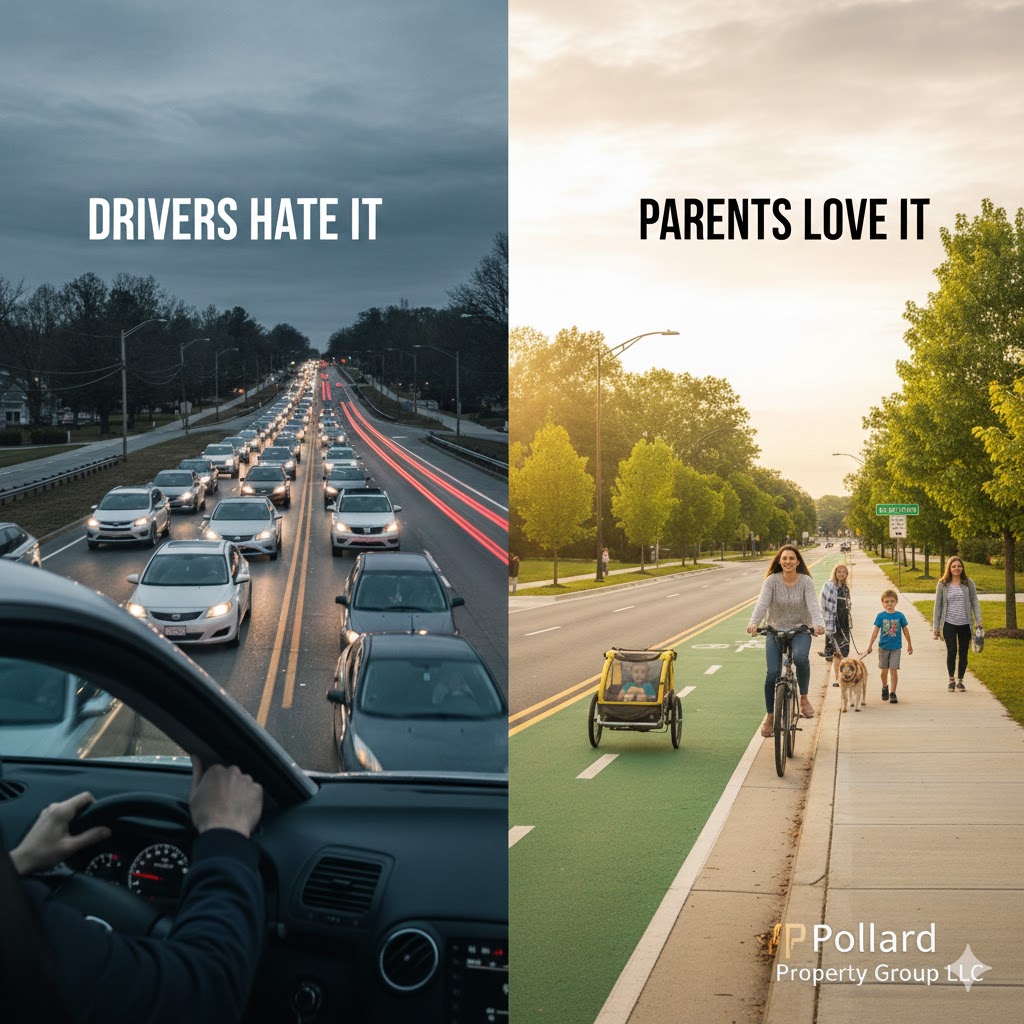
The Saint Charles Road Calming Debate: What is the 'Road Diet' and Why is Everyone Talking About it?
The Saint Charles Road Calming Debate: What is the 'Road Diet' and Why is Everyone Talking About it?
The Saint Charles Intersection That Suddenly Changed Everything
You're leaving the house for your DC commute, coffee in hand, cruising down St. Charles Parkway... and then you hit it. The lane is gone. A new center turn lane has appeared, and what used to be a steady two lanes is now a bottleneck. You’re left wondering: Who approved this, and why is it making my commute worse?
The truth is, this isn't just a random striping job. It's a calculated infrastructure redesign—a "Road Diet." And whether you're a frustrated driver or a parent happy to see slower speeds, this change is setting off the biggest real estate debate in Waldorf: Is this a necessary safety upgrade or is it secretly pushing the 301 traffic headache right into our backyards?

Deconstructing the 'Road Diet': Safety Strategy or Commuter Nightmare?
The term "Road Diet" sounds harsh, but it's a specific engineering strategy. It’s what Charles County is using to transform high-speed corridors into safer, more community-focused streets.
A Simple Definition
A typical Road Diet takes a roadway with four lanes (two in each direction, undivided) and converts it into a three-lane cross-section:
One travel lane in each direction.
One center Two-Way Left-Turn Lane (TWLTL) for everyone to share.
The space saved from those two eliminated lanes is then often repurposed for new bike lanes, sidewalks, or planted medians.
Charles County's Official Rationale: The Safety Imperative
This isn't just local chatter; it's part of the Charles County Local Roadway Safety Plan. The official goals are straightforward, aiming to address the high number of crashes in the region:
Reducing Severe Crashes: Studies show Road Diets can reduce overall crashes by 19% to 47% by cutting down on chaotic lane changes and left-turn conflicts.
Protecting Vulnerable Users: Creating dedicated space for pedestrians and cyclists, making crossing safer.
Lowering Vehicle Speeds: The narrower lanes and continuous presence of the {TWLTL} naturally slow drivers down.
The core conflict is clear: The County is prioritizing safety over raw capacity. While that's good for neighbors, for the high-speed DC commuter, it feels like a personal attack on your commute time.
Mapping the 'Road Diet': Where Are the New Chokepoints and Lane Reductions?
In Saint Charles, where every minute counts, knowing the exact changes is essential.
The Key Saint Charles Corridors Affected
While the full scope of the Local Roadway Safety Plan is massive, the core Road Diet changes are focused on high-injury sections, which include specific stretches of feeder roads like St. Charles Parkway, Smallwood Drive, and Acton Lane. These were typically four-lane roads that have now seen the visible change: Former 4-lane reduced to 2 lanes with a dedicated center turn lane.
The Unintended Consequence: The "Cut-Through" Effect
This is where the real estate controversy begins.
The biggest fear among Saint Charles homeowners is that the diet won't kill traffic—it will just make it sick. When a main road gets slower, many drivers try to avoid the new {TWLTL} bottleneck by "cutting through" inner residential neighborhoods.
This means roads around areas like Fairway Village or Piney Reach may suddenly see an increase in frantic, speed-limit-ignoring commuters trying to save 60 seconds. This "Cut-Through" Effect is the primary reason homeowners are worried about the quiet, safety, and ultimately, the value of their property.
The Saint Charles Commuter's 3-Step Survival Plan
The changes are here to stay, and the short-term inconvenience is real. Your best defense is a proactive, hyper-local strategy that turns confusion into control.
Identify Your True Commuter Window: The new bottlenecks—especially near the Acton Lane/Route 301 interchange—have shifted peak times. Given the typical Fall/Winter traffic surge in Southern Maryland as remote work lessens, you can no longer rely on old habits. Experiment with leaving the house 15-20 minutes earlier or later to skip the newly formed slow-down window in the 20602 ZIP code.
Utilize the TWLTL Correctly: The new Two-Way Left-Turn Lane (TWLTL)} is a major safety benefit when used right. Use it to pull completely out of the through-traffic lane when turning into landmarks like St. Charles Towne Center or White Plains Regional Park (which sits just off the Parkway). Proper use of the {TWLTL) prevents the whole lane from backing up.
Leverage the CPRA Amenities: If your driving life is worse, redeem the trade-off with a better quality of life. The new pedestrian and bike access are the supposed benefits. For residents in Fairway Village or Smallwood Village—where the diet is most impactful—actively use the enhanced trails to justify the lifestyle choice.
Community Voices: What Saint Charles Residents Are Saying Right Now
We hear from clients every day who are on different sides of this fence.
"I'm thrilled. I live on a corner near a school and the traffic used to scream past. Now I feel safer letting my kids walk to the bus stop. The extra five minutes to 301}is worth the peace of mind." - St. Charles Parent (Pro-Safety)
"This has been a disaster for my workday. I leave the house at 6:30 AM just to avoid 301, but now I'm stuck waiting twice as long to even get out of Saint Charles. I’m actively looking at homes farther south to cut down on the aggravation." - DC Commuter (Anti-Traffic)
Pollard Property Group LLC acknowledges the pain points. But our focus is on the long-term Complete Streets vision and how it affects your financial asset.
What Happens Next? The Question of Property Values
This is the multi-million dollar question every Saint Charles homeowner is asking: Will the Road Diet reduce the value of my home?
National studies show that Road Diets are incredibly effective at crash reduction (up to 47% in some cities). But the local home value impact is still TBD—The controversy is currently fueling buyer objections and creating uncertainty, even if the price hasn't technically dropped yet.
The financial data is coming. We are actively tracking Days on Market (DOM) and Sale Price-to-List Price Ratios in the affected Saint Charles corridors.
Next up: Does Traffic Calming Actually Drop Home Values? A Deep Dive into the Saint Charles Data.
Quick Answers on the Saint Charles Road Diet
Q: Is this a permanent change?
A: Yes. These are major infrastructure redesigns, not temporary construction fixes. The lane allocations are permanent.
Q: Does my HOA/CPRA fee have anything to do with this project?
A: Not directly. The county/state controls the major roads. However, the CPRA maintains the community and the impact is community-wide, making it a critical topic for your local association.
Q: Where can I see the official county map?
A: You can view the full Local Roadway Safety Plan on the Charles County website, but it's massive. Our exclusive map is easier to digest.
Stop Guessing About Your Saint Charles Home's Future
The road signs show you the 'what,' but our team's exclusive analysis shows you the future development risks that truly impact home value. You can't rely on national averages when your investment is hyper-local.

DOWNLOAD THE MAP: "See The Streets The County Didn't Highlight: Get the Charles County Future Development Map."
Click here to get the data and stop worrying about your home value.
