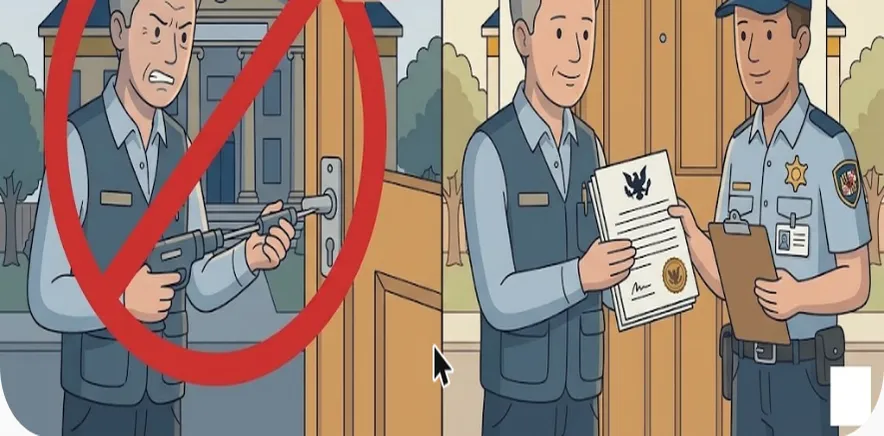
Self-Help Eviction in Maryland: Why Changing the Locks Can Cost You the Case
The Locks She Changed on a Friday Afternoon
A landlord in Mechanicsville had a tenant two months behind on rent and, out of frustration, changed the locks while the tenant was at work on a Friday afternoon. She believed she was simply protecting her property. By Monday, she was served with a lawsuit -- not from the tenant's landlord-tenant claim, but from a separate action for illegal lockout, and the tenant's unpaid rent claim against her suddenly had far less leverage than her own liability did.
She had turned a straightforward nonpayment case she likely would have won into a case where she was the one facing damages.
Why "I Own It, I Can Lock Them Out" Is the Costliest Belief in Landlording
A landlord who files for eviction through the court and lets the process run costs time -- typically weeks, sometimes longer -- but stays entirely within the law and keeps every legal remedy available, including collecting the unpaid rent that was owed. A landlord who changes locks, removes belongings, shuts off utilities, or otherwise forces a tenant out without a court order exposes herself to statutory damages, and in Maryland those damages can exceed the unpaid rent she was originally owed.
On a $1,800 to $2,200 a month Charles County rental, a self-help eviction claim can result in damages and fees that meet or exceed several months of rent -- turning a landlord who was in the right on the underlying nonpayment into a landlord who now owes money instead of collecting it. A properly filed eviction, by comparison, keeps the rent claim intact the entire time.
If a tenant is behind on rent and you are tempted to handle it yourself, that is exactly the conversation to have first on a Free Coaching Call. rental911.net/coaching
What Maryland Prohibits -- And What It Requires Instead
1. Self-Help Eviction Is Illegal Regardless of How Far Behind the Tenant Is
There is no dollar threshold or number of missed payments that makes self-help removal legal. A tenant who owes six months of rent has the same legal protection against lockout as a tenant who owes one. The amount owed affects the underlying case -- it does not create an exception to the removal process.
2. Changing Locks Is Only One Form of Self-Help -- There Are Others That Catch Landlords Off Guard
Shutting off utilities, removing a tenant's belongings, or making a unit intentionally uninhabitable to pressure a move-out are all treated as forms of unlawful self-help, even without physically changing a lock. What specifically counts, and where the line actually sits, is exactly what we walk through on a coaching call.
3. The Only Lawful Path to Removal Runs Through the Court
Regaining possession of a rental unit in Maryland requires a court filing, a hearing, and in most cases a court-ordered process for the physical removal if the tenant still does not leave. There is no shortcut that skips this sequence, no matter how clear the nonpayment case is.
4. Frustration Is Understandable -- Timing the Filing Correctly Is What Actually Protects You
The instinct to act immediately usually comes from a legitimate and mounting loss. What matters is channeling that urgency into filing correctly and promptly through the court, rather than acting outside it. What the correct filing timeline looks like for your specific nonpayment situation is exactly what we walk through on a call.
5. A Self-Help Claim Against You Can Undercut a Legitimate Nonpayment Case
Even when a tenant genuinely owes rent, a landlord who engages in self-help removal hands that tenant a counterclaim that can offset or exceed the original debt. Courts do not average the two claims evenly in the landlord's favor just because the underlying nonpayment was real.
This Is Already Happening in Your Zip Code
Self-managing landlords in Mechanicsville, Hughesville, White Plains, and Bryans Road facing frustrating nonpayment situations right now are the highest-risk group for this exact mistake -- not because they do not know eviction requires a court process in the abstract, but because frustration after months of missed rent makes a lockout feel justified in the moment. Charles County and St. Mary's County courts see self-help counterclaims tied to exactly this pattern.
Case Study: The Counterclaim That Flipped the Case
A landlord near Hughesville, owed roughly $5,400 in back rent, changed the locks while the tenant was out rather than filing for eviction. The tenant filed a counterclaim for illegal lockout that resulted in an award working out to nearly the same amount the landlord was originally owed -- effectively erasing months of legitimate unpaid rent. A properly filed eviction, filed the week the nonpayment started, would have cost a modest filing fee and preserved her full claim.
Frequently Asked Questions
What if I genuinely believe the unit has been abandoned?
Abandonment has a specific legal standard in Maryland, and assuming a unit is abandoned without meeting that standard is one of the most common ways landlords accidentally commit self-help eviction. Confirming whether your situation actually meets it is exactly a coaching call topic.
How long does the proper court process actually take?
Timelines vary by county and case type, but they are consistently faster and less costly than the fallout from a self-help claim. What to expect for your specific filing is something we map out on a call.
Can I at least enter to inspect if I suspect damage?
Entry for inspection is governed by separate notice requirements -- and entering to pressure a move-out is a different situation entirely that can itself create liability. The distinction matters and is worth confirming before you act.
Protect the Rent You Are Actually Owed
On a Free Coaching Call, we walk through exactly what Maryland requires so you know the right process to follow and the right questions to ask. If your situation needs an attorney's review, we will tell you what a Maryland real estate attorney should look at. That is the call.
