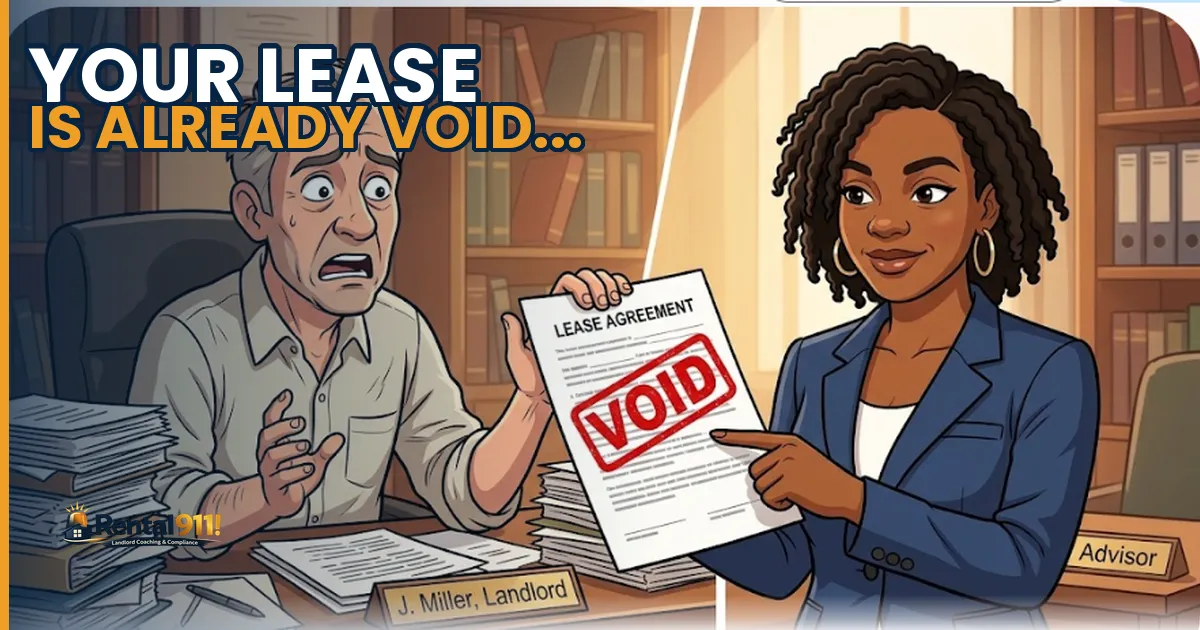
Maryland's Renters' Rights Stabilization Act: What Every Landlord Must Do Before Their Next Lease
A landlord in Waldorf spent three months trying to collect a $200 administrative fee from her tenant for late rent. Her lease authorized it. Her tenant refused to pay it. When she called Rental911 in October 2025 to ask how to enforce the clause, the answer stopped her cold: the fee provision in her lease had been void since July 1, 2025, the day the Renters’ Rights Stabilization Act took effect. She had been collecting an unenforceable fee for months. Her tenant knew it. And the same audit that caught the fee clause found two more void provisions in her lease — including the liability waiver she believed protected her from habitability disputes. She had been carrying three legal liabilities in one document and had no idea.
Maryland’s Renters’ Rights Stabilization Act (House Bill 693, effective July 1, 2025) changes the rules on every residential lease in the state in two concrete ways: it requires landlords to include a specific mandatory disclosure in every lease and every renewal, and it voids a defined set of lease clauses outright — without any court proceeding, without any tenant challenge, and regardless of when the tenant signed.
The Problem: Your Lease May Already Be Working Against You
The Renters’ Rights Stabilization Act does not grandfather in existing leases. If your lease contains a prohibited clause, that clause is void right now — regardless of when your tenant signed it, regardless of whether anyone has raised the issue, and regardless of how long you have been enforcing it. Both parties are bound by what Maryland law allows, not by what the document says.
The risk is not abstract, and it is not small. A tenant who knows their rights can raise void lease clauses as a defense in any legal proceeding, including an eviction case. When that happens, a judge who finds prohibited language in your lease does not just throw out that clause — it reframes every subsequent question about your conduct as a landlord. For a Southern Maryland landlord managing one rental property, a single dismissed eviction case means four to six months of lost rent while the tenant remains in the unit. At Charles County rental rates of $1,800 to $2,200 per month, that is $7,200 to $13,200 in unrecoverable income — before attorney fees. The lease is not paperwork. It is the only document standing between you and that number.
If you are not certain your lease is compliant with Maryland’s 2025 updates, book a Free Coaching Call before your next tenant interaction: rental911.net/free-coaching-call
Five Things Every Maryland Landlord Must Get Right Under the Renters’ Rights Stabilization Act
1. Your Lease Is Likely Missing a Required Disclosure — and Most Southern Maryland Landlords Have Not Caught Up Yet
The Renters’ Rights Stabilization Act requires landlords to include a specific mandatory disclosure in every residential lease and every renewal. Your lease is likely missing it. Most Southern Maryland landlords who have not had their lease reviewed since before July 2025 are operating without it — and that gap does not stay invisible. The moment a tenancy sours, it is the first thing an opposing attorney checks. What the disclosure needs to say, and how it needs to appear in a Maryland rental agreement, is exactly what we walk through on a coaching call. The post gives you the law. The call gives you your lease.
2. Remove Every Clause That Waives a Tenant Right Granted by Statute
Maryland law prohibits lease clauses that waive rights tenants hold by statute. The Renters’ Rights Stabilization Act codifies and strengthens this prohibition. Clauses that purport to waive notice rights, declare all deposits non-refundable regardless of condition, limit the landlord’s liability for habitability conditions, or require tenants to waive jury trial rights in landlord-tenant disputes are void. They cannot be enforced even if your tenant signed the lease willingly and never raised an objection. If those clauses are in your lease template, remove them now. They are not protecting you — they are a liability waiting for a tenant to find them.
3. Audit Your Fee Structure Against the New Standards
The Act draws a sharper line around which fees are permitted and which are not. Late fees must comply with Maryland Real Property Article § 8-208, which caps them at 5% of the monthly rent. Any lease provision establishing a flat administrative fee for late payment, a returned-check processing fee beyond the statutory limit, or a recurring penalty for lease violations is subject to challenge. Landlords who have been collecting out-of-limit fees since July 1, 2025 may be required to return them — and a non-compliant fee structure exposed in an eviction hearing can turn a straightforward case into a counterclaim. Fix the lease before the fee is challenged in court.
4. Update Month-to-Month Tenants Before the Next Cycle
Month-to-month tenancies renew automatically. If your tenant has been month-to-month since before July 1, 2025, they have already cycled through multiple renewals without a compliant document. The right move is a written addendum to the existing lease: add the required disclosure, identify and remove any void clauses, and have the tenant sign an acknowledgment of receipt. This does not require ending the tenancy or issuing a full lease renewal. It is an addendum — delivered, signed, and retained. The landlords who have not done this yet are accruing compliance exposure with every monthly cycle.
5. Document Every Lease Transaction Going Forward
The Renters’ Rights Stabilization Act raises the documentation standard for every Maryland landlord. Every lease signing should now produce a signed acknowledgment that the tenant received the required disclosure, a countersigned copy of the lease itself, and a move-in checklist. If you are ever challenged on compliance, your defense rests entirely on what you can prove you provided and when. Verbal conversations are not proof. Emails without attachments are not proof. Signed, dated documents are. Build that file from day one of every tenancy.
What Self-Managing Landlords in Southern Maryland Are Getting Wrong
In Charles County, where the rental market in Waldorf (20601, 20602, 20603) and La Plata (20646) has tightened over the past two years, most self-managing landlords are operating on lease templates that have not been reviewed since before 2020. Many use forms downloaded from real estate websites, template marketplaces, or — most commonly — the lease they inherited when they acquired the property. None of those leases include the required disclosure. Most contain at least one clause that is now void. And none of the landlords using those leases know it, because no one has challenged them yet.
In St. Mary’s County, landlords in Leonardtown (20650) and Mechanicsville (20659) face an additional complication: rental licensing requirements that interact directly with lease compliance. A landlord without a valid license cannot enforce a lease; a landlord with a non-compliant lease may face complications at licensing renewal. Both problems need to be addressed together. Fixing one without the other leaves the exposure intact.
What It Cost One La Plata Landlord
A landlord in La Plata received a letter from a tenant’s attorney three months after the Renters’ Rights Stabilization Act took effect. The tenant had stopped paying rent, citing the landlord’s failure to include the required disclosure at lease signing as grounds for withholding payment. The landlord had a signed lease, a clean payment history, and no prior disputes. What the landlord did not have was documentation of the required disclosure being provided. The attorney’s letter cited the omission as evidence of a defective tenancy. By the time the matter resolved, the landlord had paid $1,200 in attorney fees, lost $2,600 in withheld rent during the dispute period, and spent $400 having the lease brought into compliance — a $4,200 lesson in what a single missing disclosure costs in a Maryland District Court proceeding.
Frequently Asked Questions
Does the Renters’ Rights Stabilization Act apply to leases signed before July 1, 2025?
Yes. The void-clause provisions apply to all existing leases. Prohibited clauses in pre-existing leases became void on July 1, 2025, regardless of when the tenant signed. The disclosure requirement applies to new leases and renewals executed on or after July 1, 2025. If your lease automatically renewed after that date, the disclosure requirement applies to that renewal.
What if my tenant already signed a lease with a prohibited clause?
The clause is void whether or not the tenant signed it. Both parties are bound by what Maryland law permits, not by what the lease says. The correct approach is a written addendum that removes the void clause and has the tenant sign acknowledging the update. This protects both parties and eliminates the ambiguity before it becomes a dispute.
Can I use the same lease template for my Charles County and Prince George’s County properties?
Not without a county-specific compliance review. Charles County has rental licensing requirements that impose additional disclosure obligations. Prince George’s County has some of the most detailed landlord-tenant regulations in the state, including rent stabilization provisions in certain areas that directly affect lease terms. A template compliant in one county may have significant problems in another. Each property deserves a review against the rules that apply to its specific location.
Closing
Maryland changed the rules on July 1, 2025. You now know what the law requires. The question is whether your specific lease — the one your tenant signed — actually meets it. That is not a question this post can answer for you. It requires someone to look at your document. On a Free Coaching Call, we walk through exactly what Maryland requires so you know the right questions to ask and what to look for in your lease. If it needs updating, we will tell you what a Maryland real estate attorney should review. That is the call. Book it before your next tenant interaction makes the answer urgent.
Book a Free Coaching Call: rental911.net/free-coaching-call
