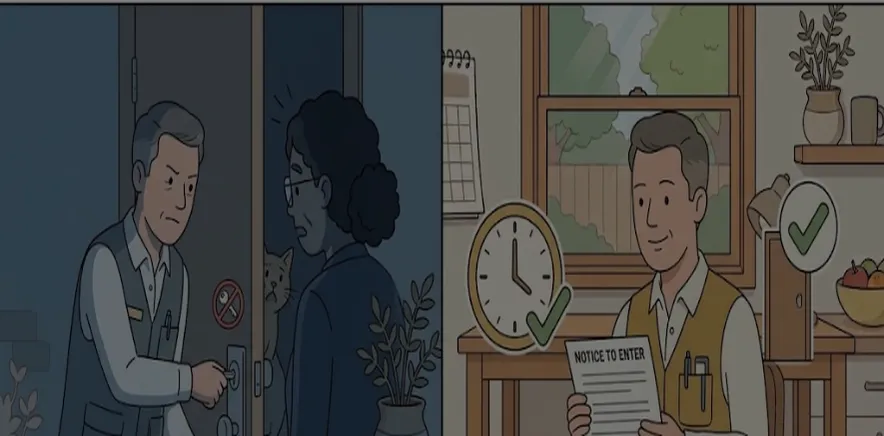
Landlord Right of Entry in Maryland: What Counts as Legal Notice
The Text That Cost a Waldorf Landlord $650
A landlord in Waldorf let herself into a rental on Middletown Road to check a reported leak. She used her key. She did not knock, did not call ahead, and did not send written notice. The tenant was home, in the shower, and did not hear her come in.
Three weeks later she was served with a small claims filing. The tenant's total: $650 in damages for an unlawful entry, plus the filing fee. She had every right to be concerned about the leak. She had no right to walk in the way she did -- and she did not know it was already a violation before she turned the key.
What "The Landlord Just Owns It" Actually Costs
Most self-managing landlords in Charles, St. Mary's, and Calvert County still operate on the assumption that ownership equals access. It does not. Maryland law treats a signed lease as a transfer of the right to exclusive possession -- the tenant's right to be free from entry, not just the landlord's right to inspect.
Here is where the dollar math gets uncomfortable. A properly documented entry notice costs a landlord nothing but five minutes and a text message or letter. An improperly documented entry -- even one made with good intentions, like checking a leak or showing the unit to a contractor -- can cost a landlord a small claims judgment, a tenant who now distrusts every future request, and in repeat cases, grounds for the tenant to argue constructive eviction.
On a $1,800 to $2,200 a month Charles County rental, a tenant who successfully argues the lease was violated by repeated unlawful entry can walk away from the unit with no notice and no further rent obligation. That is $1,800 to $2,200 in lost income per month until the unit is re-leased -- on top of whatever damages a court awards. A five-minute notice avoids all of it.
If you are not sure your current entry practices would hold up in front of a Charles County District Court judge, that is exactly what we walk through on a Free Coaching Call. rental911.net/coaching
What Maryland Actually Requires Before You Use Your Key
1. Notice Is the Default, Not the Exception
Unless there is an emergency -- meaning an immediate threat to life or property, like a gas leak or active fire -- a landlord does not have a blanket right to enter a rental unit whenever convenient. The lease determines the specific notice terms, but the underlying principle across Southern Maryland courts is the same: the tenant's possession is exclusive, and entry without proper notice is treated as a trespass onto the tenant's leased space, not a landlord exercising ownership.
2. What Counts as "Reasonable Notice" Is Narrower Than Most Landlords Assume
A text sent five minutes before showing up at the door is not reasonable notice in the eyes of most Maryland courts, even if the tenant does not respond to say no. What Maryland courts actually look for when reasonable notice is challenged, and how that standard should be written into a Southern Maryland lease so it holds up if it is ever contested, is exactly what we walk through on a coaching call. The post gives you the law. The call gives you your lease.
3. Purpose Matters -- and Has to Be Disclosed
Entry for a specific stated purpose -- a repair, an inspection, a showing -- is treated differently than entry with no stated purpose. A landlord who enters "just to check on things" with no documented reason has the weakest possible position if that entry is ever challenged. The purpose has to be identifiable, and ideally, documented in writing before the entry happens.
4. A Key Does Not Equal Consent
This is the mistake that catches the most self-managing landlords. Owning the property and holding a key does not create an exception to notice requirements. The lease is what governs access once a tenant has moved in -- not the deed. Landlords who treat their key as a standing right to enter are the ones who end up on the wrong side of a small claims filing.
5. Repeated Violations Compound the Risk
One undocumented entry might get written off by a judge as an honest mistake. A pattern of them is what tenants' attorneys look for when building a case for constructive eviction or lease termination without further rent liability. Southern Maryland landlords who self-manage several units are the highest-risk group here, simply because the volume of entries -- repairs, showings, inspections -- creates more opportunities for the pattern to form.
This Is Already Happening in Your Zip Code
Self-managing landlords in Waldorf (20601, 20602, 20603), La Plata (20646), Leonardtown (20650), and Prince Frederick (20678) are managing this exact exposure right now, often without knowing it. Charles County District Court and St. Mary's County District Court both see small claims filings tied to entry disputes every quarter -- most of them from landlords who believed a phone call or a key was enough. It usually was not.
Case Study: The $650 Lesson
A landlord managing a single-family rental near St. Charles entered the unit twice in one month to meet contractors for a quoted repair, using her own key both times without written notice to the tenant. The tenant filed a small claims complaint for unlawful entry. Total cost to the landlord: $650 in awarded damages plus the filing fee, and a tenant who gave 30-day notice the following month rather than renew. A single written notice template, used consistently, would have cost her nothing and kept the lease -- and the tenant -- intact.
Frequently Asked Questions
Does a real emergency change any of this?
Yes. A genuine emergency -- fire, flooding, gas smell, anything posing an immediate risk to life or property -- allows entry without advance notice. The bar for what counts as an emergency is narrower than most landlords assume, and documenting the emergency after the fact matters. That documentation standard is part of what we cover on a coaching call.
Can I just put a blanket entry clause in my lease and be covered?
A lease clause helps, but only if it is written to match what Maryland courts actually enforce. A poorly worded entry clause can create a false sense of security. What your lease needs to say, and how it needs to appear in a Maryland rental agreement, is exactly what we walk through on a coaching call.
What if the tenant just never responds to my notice?
Silence is not the same as consent, and it is not the same as a denial either. There is a specific way to document that notice was given and proceed appropriately even without a response, so you are protected either way. That is a coaching call topic, not a blog post topic -- because the answer depends on your specific lease language.
Get This Right Before It Costs You $650 -- Or More
On a Free Coaching Call, we walk through exactly what Maryland requires so you know the right questions to ask and what to look for in your lease. If it needs updating, we will tell you what a Maryland real estate attorney should review. That is the call.
